

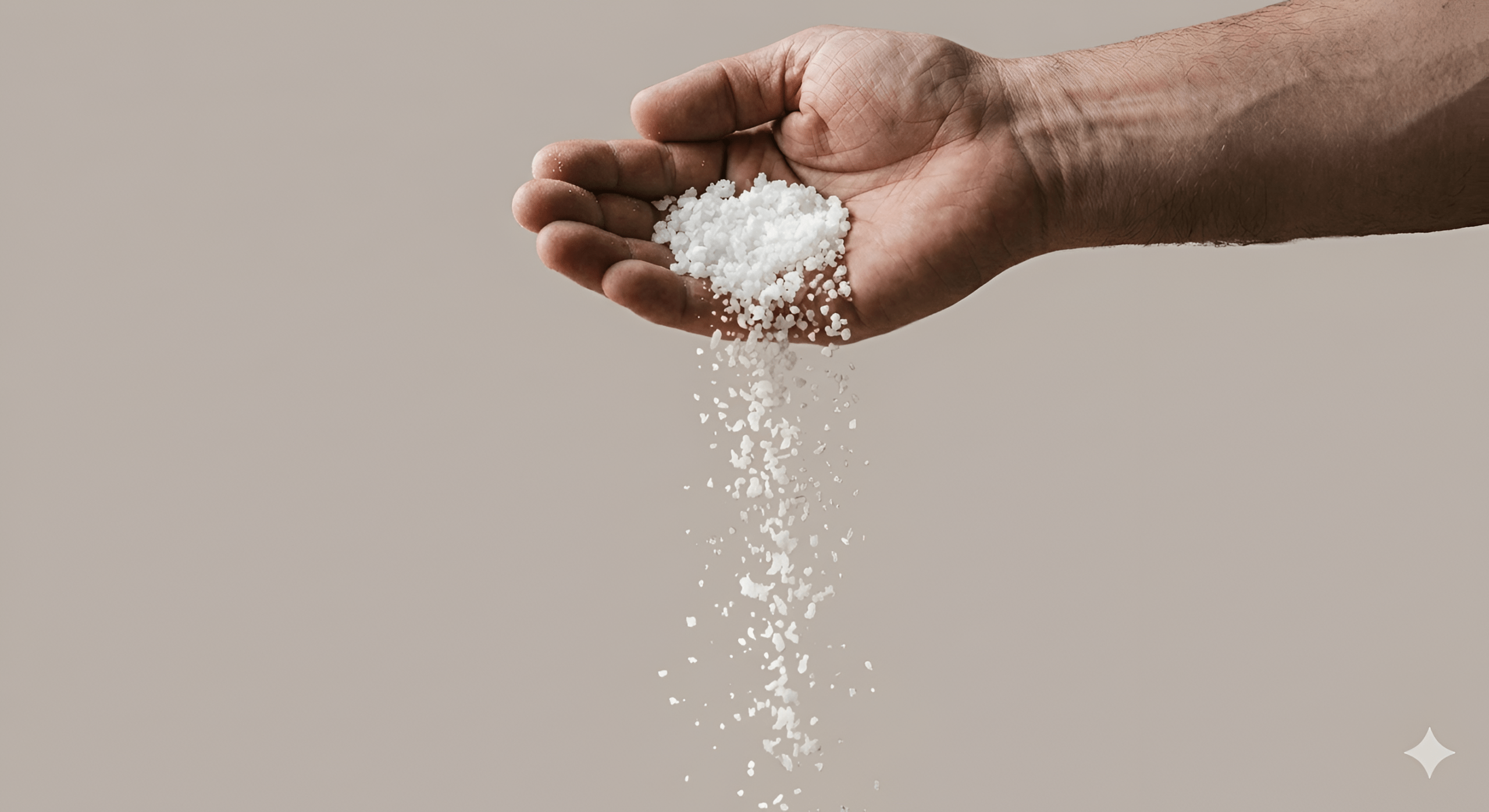
For some time now, salt has gained a bad reputation through imprecise opinions. For that reason, we constantly hear messages such as “salt is bad”, “the less, the better”, or “the healthiest option is to cut it out of your diet”.
However, it is important to put the amount consumed into context and bear in mind the role this ingredient plays in health. Even international authorities such as the World Health Organization (WHO) advocate responsible consumption.
First of all, it should be noted that salt is not bad in itself. In fact, the sodium it contains is necessary for basic bodily functions. The problem arises when consumption becomes excessive, especially through processed and ultra-processed products, which account for a large share of the salt we habitually consume.
So, is salt bad? The answer is no. What is harmful is consuming it in excess and, moreover, doing so as part of an unhealthy diet. That is why it is also worth distinguishing between a highly refined industrial salt and an artisanally harvested natural sea salt.
Below, we debunk the most common myths about salt, review what science says on the matter, and explain why more and more people are looking for a more natural, less processed salt for their meals.
What does salt do in the body?
Before demonising it, it is worth remembering something essential: the body needs sodium, which salt is rich in.
This nutrient takes part in processes as important as maintaining fluid balance, muscle function, the transmission of nerve impulses, and blood pressure regulation, among others, providing the richness of a complete salt with minerals for the proper functioning of the body.
Therefore, claiming that salt is bad without nuance is an oversimplification. Furthermore, an extremely low-sodium diet is not always the best option for everyone, since in certain medical situations recommendations must be individualised and guided by a healthcare professional.
How much salt is recommended per day?
As a general rule, the WHO advises not exceeding 5 grams of salt per day.
That said, most of the salt we consume does not come from the salt shaker, but from processed foods such as industrial bread, cured meats, cheeses, sauces, or ready meals that we include in our daily diet.
Popular myths about salt
“Salt is bad for your health”
Probably the most widespread myth, and it is not accurate. Scientific evidence does not say that all salt is bad, but rather that excessive sodium consumption can be harmful, especially for certain population groups.
However, the solution is neither to eliminate it completely nor to believe that all types of salt are the same. After all, following a diet rich in industrial food is not the same as preparing home-cooked dishes where a moderate amount of natural salt is used to enhance the flavour of food.
“It is best not to eat any salt”
Another statement that is not true. In fact, eliminating salt completely is not a recommendation that applies to everyone. Indeed, overly restricting sodium intake can also have a negative impact on health.
For that reason, experts suggest checking where most of the salt we consume daily comes from by reading food product labels, as well as reducing ultra-processed food and opting for home cooking.
Remember, removing the salt shaker from the table does not solve the problem if the diet you follow is unhealthy.
“Salt makes you gain weight”
Having dispelled the idea that salt is bad, it is time to address another misconception.
Salt provides no calories, so it does not make you gain weight in the strict sense of increasing body fat. What can happen is that an excess of salt may promote fluid retention in some people. That feeling of bloating may make you think that salt causes weight gain, but retaining fluids is not the same as gaining fat.
Moreover, many high-salt foods also tend to be unhealthy products with excess fats, sugars, or refined flours, so salt is often blamed for something that actually has much more to do with the diet as a whole.
“All salt is the same”
Finally, we come to an important point worth clarifying. The fact that all types of salt contain sodium does not mean that, for example, refined salt and sea salt are the same.
While the former usually undergoes intensive refining processes and often includes additives such as anti-caking agents, virgin sea salt is obtained from the natural evaporation of seawater.
That is why more and more people choose organic sea salt, as its origin is natural, it does not require aggressive refining, it is free from artificial additives, and it fits better into a kitchen based on fresh ingredients.
An example of this is Dama Blanca, a sea salt obtained in the salt pans of Cádiz through an artisanal process that respects the natural rhythm of the sea. For those who wish to follow a more mindful diet that is less dependent on ultra-processed ingredients, this type of salt truly makes a difference.
In conclusion, salt is not bad in itself; the problem lies in the way we have learned to consume it. For years we have normalised daily diets full of refined ingredients, additives, and ready-to-eat products, leading us to lose track of the actual amount of salt we consume and where it comes from.
If you are looking for a natural salt, obtained from the sea and crafted in an artisanal way, visit the Dama Blanca online shop and discover our selection of fleur de sel, salt flakes, fine virgin sea salt and coarse virgin sea salt.
Frequently asked questions
Does all the salt we consume come from the salt shaker?
No, a large part comes from processed and ultra-processed foods that contain high amounts of salt.
Does salt make you gain weight?
Salt provides no calories, so it does not cause weight gain on its own. What can happen is that excessive consumption may promote fluid retention in certain people.
Is salt bad for blood pressure?
It is excess salt that can raise blood pressure, especially in people who are more sensitive to this condition.
Is sea salt better than refined salt?
It is a matter of choosing a less processed ingredient, free from artificial additives and of natural origin, as is the case with sea salt.
References
- Salt in the diet (Clínica Universidad de Navarra).
- Responsible sodium intake (Mayo Clinic).
- How to read nutrition labels to control sodium in your diet (U.S. Food and Drug Administration or FDA).
- Moderate salt consumption (World Health Organization).