

To answer these questions, we first need to distinguish the type of salt and, above all, check what its label indicates. In this guide we explain what iodised salt is, what role it plays in nutrition, the benefits it offers, and how to make an informed choice when selecting the best iodised salt—without losing sight of what matters most: moderate consumption.
Does salt contain iodine?
The short answer is that not all salts contain iodine. For that reason, it is essential to check whether the word “iodine” or “iodised” appears on the label of the package, specifically in the nutritional information section.
Indeed, many people wonder whether sea salt contains iodine, and the reality is that it can contain it, but in variable amounts. That is why checking the label is decisive when confirming whether it is iodised sea salt.
What is iodised salt and what is it used for?
Iodised salt is a food-grade salt that provides iodine, a micronutrient involved in the body’s thyroid function as well as in pregnancy development, breastfeeding, and childhood—although in these cases it is always best to consult a healthcare professional.
As for the benefits of iodised salt, it contributes to the proper functioning of thyroid hormones, which take part in regulating metabolism. One of their tasks, for example, is to control the rate at which the body burns calories and produces energy.
Conversely, iodine deficiency can cause goitre, thyroid nodules, and metabolic problems, as warned by the Spanish Society of Endocrinology and Nutrition.
Thus, one of the main benefits of iodised salt is that it can easily help cover dietary iodine intake.
Dietary sources of iodine
Broadly speaking, iodine can be found in:
- Fish
- Seafood
- Dairy products
- Eggs
The key lies in complementing the use of iodised salt with an iodine-rich diet by eating foods such as those mentioned above.
Salt and iodine alongside other natural minerals: their importance for health
Sodium chloride and other natural minerals
There are salts whose profile is closer to almost pure sodium chloride, and others that naturally retain a series of trace elements—essential minerals for the proper development of physiological functions.
At Salinas de Cádiz we understand that when it is obtained through an artisanal and environmentally respectful process like the one we carry out, salt can retain those natural minerals in addition to sodium chloride, becoming an essential salt with minerals for the body.
How much iodine is in sea salt?
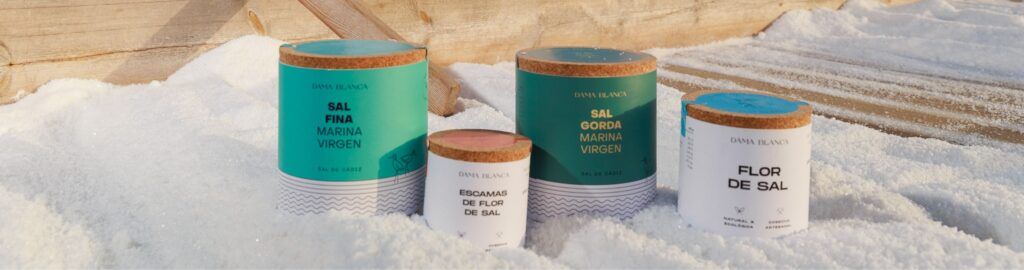
In the case of our virgin sea salt, whether fine salt or coarse salt, the harvesting and drying process we carry out allows the salt to retain that natural iodine.
It should be noted that other products in our range, such as sea salt fleur de sel or sea salt flakes, contain 23 μg of iodine per 100 grams.
Beyond the information provided on the label, our salt not only contains natural iodine, but also delivers a flavour that enhances dishes rather than masking them as other more artificial salts can do.
How to make an informed choice of iodised salt
If you are looking for the best iodised salt, it is important to bear the following aspects in mind:
- The label states the word “iodine” alongside the amount it contains.
- The intended use. For everyday cooking, you will want a type of salt that is easy to measure out. If, on the other hand, you want to add a finishing touch to your dishes, formats such as fleur de sel or salt flakes can provide an enriching, irresistible texture.
- Remember that what matters most is not so much the type of salt as the amount consumed. Much of our salt intake comes through processed foods. For that reason, authorities such as the World Health Organization recommend limiting daily intake to less than 5 grams of salt per adult.
Responsible consumption
By making small changes you can achieve a major positive impact on your eating habits, such as getting into the habit of adding salt at the end of a recipe, which helps you better control the amount you consume. Also bear in mind that other foods already contain salt, such as bread, cured meats, or sauces.
Furthermore, it is important to use salt as an ingredient to enhance rather than to create flavour. For the latter, there are other natural resources such as lemon, onion, garlic, pepper, cumin, fresh herbs, or vinegar.
Frequently asked questions about salt and iodine
Is sea salt iodised?
Yes, although the amount can vary. It is advisable to check the product’s labelling and nutritional information.
What is the difference between common salt and iodised salt?
In practical terms, the main difference lies in its label and whether it indicates the presence of iodine in its composition.
What is iodised salt used for?
It is associated with providing iodine in the diet, a nutrient linked to thyroid function, which is essential for the body.
Is iodised salt good for everyone?
It is a common option, although if you suffer from any thyroid condition it is advisable to consult a medical professional.
Is iodine lost when cooking?
It depends on the type of product and how it is used.
Which foods contain iodine besides salt?
In general, fish, seafood, and some foods of animal origin, although the amount can vary depending on diet and production.
References
- Effects of iodine deficiency according to the Spanish Society of Endocrinology and Nutrition.
- Recommendation on moderate salt consumption by the World Health Organization: less than 5 grams per day per adult.
- Iodine values in Dama Blanca salt: 23 μg in sea salt fleur de sel and flakes.